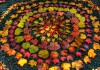



The Pavilion of Ecuador at Biennale Arte 2026 presents Tawna & Óscar, an exhibition that challenges dominant ways of organizing life, knowledge, and territory. Featuring the Tawna collective and Óscar Santillán, and curated by Manuela Moscoso with the support of its commissioner, the Museum of Anthropology and Contemporary Art of Ecuador (MAAC), the project approaches art as a practice of attention.
Tawna & Óscar brings together the practices of Óscar Santillán and the Tawna collective to present two contemporary ways of thinking and making the world through relation. The project proposes an approach to art that moves away from fixed categories and closed hierarchies, focusing instead on processes of exchange that unfold across bodies, languages, territories, and times.
Curated by Manuela Moscoso, the Pavilion of Ecuador is conceived as a space of attention and listening. Rather than offering a single narrative, it invites visitors to slow down and engage with forms of knowledge that are often overlooked within dominant cultural frameworks. Emerging from Andean-Amazonian territories marked by linguistic, cultural, and ecological plurality, the project advances a situated position that understands knowledge as something produced through shared experience and ongoing relation.
The practice of the Tawna collective is rooted in Pan-Amazonian ways of thinking that conceive existence as an active continuity among bodies, territories, and forces. Working from community-based and embodied experiences, Tawna understands sexuality and dreaming as sensitive technologies through which life is oriented, knowledge is transmitted, and care is organized. In their practice, language functions not as distant representation but as a living force that participates in the making of the world, activating connections between the personal, the collective, and the spiritual.
Óscar Santillán’s practice explores what exists beyond established notions of reality: those conditions that escape dominant systems of order and open other ways of perceiving the world. Moving across science, emerging technologies, and ancestral knowledge, his work insists on indeterminacy as a fundamental condition of life. From this perspective, the terrestrial, the technological, and the cosmic are understood as interconnected and continuously shaping one another.
The encounter between Tawna and Santillán does not aim for synthesis or resolution. Instead, it sustains an open space in which different ways of inhabiting and understanding the world can coexist without being reduced to a single framework. Art operates here as a practice that holds this openness, creating the conditions for new forms of perception, relation, and coexistence.
Rather than representing a fixed national identity, Tawna & Óscar proposes a contemporary position grounded in situated knowledge, relation, and material responsibility, offering tools to think with the present and imagine multiple possible worlds.
ARTISTS
OSCAR SANTILLÁN is an Ecuadorian artist working between Ecuador and the Netherlands. His practice explores science, ancestral technologies, and the concept of the “Anti-world,” dissolving boundaries between the natural and artificial. His work has been shown internationally and he is active in art education.
TAWNA is an anti-colonial collective of Sápara, Kichwa, and mestizo artists founded in 2017. Working with video, photography, and living archives, they create narratives from Amazonian territories through ritual, dreaming, and community-based processes. Their work has been shown internationally.
CURATOR
MANUELA MOSCOSO is the inaugural Executive and Artistic Director of the Center for Art, Research and Alliances (CARA) and, in 2025, curated the 2ª Bienal das Amazônias. Formerly curator of the Liverpool Biennial (2021) and a senior curator at Museo Tamayo, Moscoso focuses her work on relational, political, and embodied approaches to contemporary art and institutions.
COMMISSIONER
The Museum of Anthropology and Contemporary Art (MAAC) is a key cultural institution in Ecuador, dedicated to preserving archaeological and modern heritage, promoting contemporary art, and serving as a bridge between the country’s historical memory and its present cultural landscape. As custodian of 60,000 pre-Hispanic archaeological objects and 3,500 works of modern and contemporary art, the MAAC fosters spaces for encounter, critical reflection, and research. With approximately 120,000 annual visitors and a strong public program, it has established itself as a dynamic institution with an international outlook.
INSTITUTIONAL LEADERSHIP Romina Muñoz Procel (Vice Minister of Culture of the Ministry of Education, Sports and Culture, Ecuador), Stephanie García Albán (Executive Director MAAC)
PRODUCTION & PR Anna Shvets TAtchers’ Art Management
EXHIBITION DESIGN Studio Manuel Raeder
SUPPORTERS Embassy of the Republic of Ecuador in Italy, Vice Ministry of Tourism of Ecuador, Ministry of Foreign Affairs of Ecuador, Identidad Nacional Foundation, EACHEVE foundation, Pily Estrada Lecaro, Instituto de Promoción del Ecuador (PRO ECUADOR), Imprenta Mariscal,
_________________________________________________________________________________________ PAVILION OF ECUADOR – ADDRESS: Castello 1636/A, Venice, Italy
OPENING: Wednesday 6 May, 4 PM, RSVP by 4 May to [email protected]
OPEN TO THE PUBLIC May 9 – November 22, 2026, daily except Monday, free entry. May: 11 – 6 PM, June: 11 – 5 PM, July-November: 11 – 4 PM
MEDIA CONTACT: [email protected] WhatsApp: +7 903 2252210, Tg/ Mob: +593 96 773 0929 MORE INFO: https://pavilionofecuador.art, https://www.instagram.com/maacec
#EcuadorPavilion #PavilionOfEcuador #TAWNA #OscarSantillan #MAAC #ContemporaryArt #BiennaleArte2026 #InMinorKeys
TAWNA is an anti-colonial collective formed by Sápara, Kichwa, and mestizo artists who create from the rainforest as a territory of memory, resistance, and vision. Founded in 2017, their practice explores video, photography, and living archives to reimagine narratives through dreams, ritual, and the embodied. TAWNA, like the ancestral tool that propels the canoe, connects territories, affections, and futures from its Amazonian roots. The collective members are Sani Montahuano (1997 –
Puyo, Ecuador). Enoc Merino (1990 – Puyo, Ecuador), Mukutsawa Montahuano (2002 – Llanchama, Ecuador), Boloh Miranda (1986 – Quito, Ecuador), Ipiak Montaguano (2003 – Puyo, Ecuador), Tatiana López (1990 – Ambato, Ecuador), Lucía Ferré (1987 – Marseille, France).
Their projects consist of multidisciplinary collective works and educational processes with Amazonian communities that converge toward the creation of their own intimate, collective, and experimental narratives from their territories. Over the past five years, their work has been exhibited in several prominent shows. Their work includes “But the Light Will Come Tomorrow for the Most” at the Museo Nacional Centro de Arte Reina Sofía, “Brain Forest Quipu” by Cecilia Vicuña at Tate Modern, and “Water Pressure: Designing for the Future” at MK&G Hamburg. They also participated in the 14th Cuenca Biennial with Augusto Ballardo, and in the solo exhibition “Ways of Resisting” at Arte Actual Flacso. Their work was part of the “E·CO/23” exhibition by Vist Project at the CCE in La Paz and Mexico City. Furthermore, they won the E·CO/23 grant, participated in VERDE
DISTÂNCIA: LA 2ª BIENAL DAS AMAZÔNIAS 2025, and won the National Geographic Storytellers program with the documentary “Allpamanda,” which received an award at the Edoc festival. Their films have been shown at festivals such as Edoc, the Toronto Film Festival, Camara Lucida EFF, the Vancouver LQFF, LatinArte FF, the Festival Rabia, and the Global Landscapes Amazon FF, among others.
Oscar Santillan is an Ecuadorian artist committed to curiosity as a mode of engaging with worlds as divergent as science, ancestral technologies, and the sensuality of all that is alive — including what is often assumed to be “inert.” His artistic formation has been productively nonlinear. It began with an unsuccessful attempt to become a writer, which evolved into a self-directed education within the artist collective Lalimpia. After several years, he pursued more formal studies at ITAE, an experimental art school founded by local artists. He later received a scholarship to complete an MFA in Sculpture at Virginia
Commonwealth University (VCU) in the United States. Since then, his practice has moved across geographic borders and artistic disciplines. In 2013, he was appointed artist-in-residence at the Jan van Eyck Academie in the Netherlands — a turning point that enabled him to live and work between the Netherlands and Ecuador.
In recent years, the concept of the “Anti-world” has become a central force within his practice. At first glance, being “anti-world” might appear paradoxical, yet it hinges on distinguishing between “world” and “planet.” Our planetary reality is vast and capable of hosting multiple worlds. The Anti-world suggests the plurality of worlds obscured by hegemonic frameworks — normative systems that attempt to delimit what can be imagined. Beyond its political implications, the concept also gestures toward a planetary imagination — one that dissolves boundaries between beings and things, the natural and the artificial.
These ideas have shaped projects exhibited internationally at Guggenheim Bilbao, LACMA, the Yokohama Triennale, MUAC, RADIUS, the Diriyah Biennale, Melly Kunstinstituut, SongEun Art Space, NRW FORUM Düsseldorf, and FRAC Île-de-France, among others. Alongside his exhibitions, he has published essays — some developed into books such as The Andean Information Age and La Luz Del Sol Menos Una Luciérnaga — and contributed to anthologies including What Is It Like To Be Earth, which also titled his recent exhibition at the Centro de Arte Contemporáneo in Quito. Committed to artistic education as a vital way of thinking and embracing complexity amid global instability, he maintains an active pedagogical practice as an advisor at De Ateliers in the Netherlands and as a visiting professor at ESPOL in Ecuador.
MEDIA CONTACT: [email protected] WhatsApp: +7 903 2252210, Tg/ Mob: +593 96 773 0929 MORE INFO: https://pavilionofecuador.art, https://www.instagram.com/maacec
#EcuadorPavilion #PavilionOfEcuador #TAWNA #OscarSantillan #MAAC #ContemporaryArt #BiennaleArte2026 #InMinorKeys