


Barry X Ball’s Venice exhibition turns a historic abbey into a study in scale, memory, and religious imagery
At the Abbey of San Giorgio Maggiore in Venice, Barry X Ball has installed a body of work that moves between devotional form and contemporary fabrication. The exhibition, “The Shape of Time,” organized by curator Bob Nickas, brings together 23 works, many of them shown publicly for the first time, and places Ball’s sculpture Pope Saint John Paul II (2012–24) at its center.
The piece is small enough to fit within the church’s choir, yet its surface carries an unusual density of detail. Made over twelve years in collaboration with Italian jewelry house Damiani, it combines silver and 18 karat gold in a portrait of the Polish pope, whose global visibility in the 1970s and ’80s made him one of the most recognizable religious figures of the late 20th century. Ball has embedded references to Hitler, Stalin, Lenin, skis, a bullet, and the 1981 assassination attempt on John Paul II by Mehmet Ali Ağca. He also points to the pope’s visits to Jerusalem and the three Abrahamic religions, giving the work a layered historical and theological frame.
The setting matters. Designed by Andrea Palladio and completed in 1610, San Giorgio Maggiore is one of Venice’s most recognizable landmarks, and the Benedictine community that oversees the site has made contemporary art part of its mission. The abbey has previously hosted exhibitions by Berlinde de Bruyckere, Anish Kapoor, Jaume Plensa, Luc Tuymans, and Ai Weiwei, continuing a long tradition in which religious institutions commissioned leading artists of their time.
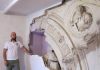
Ball’s broader installation extends into the nave and transept. Among the works on view are Pietà (2011–22), inspired by Michelangelo’s unfinished Pietà Rondanini, and Saint Bartholomew Flayed (2011–20), which draws on Marco d’Agrate’s sculpture in Milan’s Duomo. Ball has said that Michelangelo’s late work, long neglected, suggested a funerary monument in progress; in his own version, he altered Christ’s face to resemble Michelangelo.
The exhibition also reflects the artist’s method. In his Greenpoint, Brooklyn studio, Ball uses computer programs, 3D scanning and printing, and extensive hand finishing, with about fifteen artists working full time. That combination of digital precision and manual labor gives his sculptures their polished, almost improbable finish — a surface language that feels at once ancient and technologically exact.
Ball’s market history underscores his standing. His highest recorded auction price cited in the exhibition material is $545,000 for Sleeping Hermaphrodite (2008–10), sold at Christie’s New York in 2016. In Venice, though, the emphasis is less on the market than on how Ball retools art history, religious iconography, and fabrication into objects that ask to be read slowly.