


Werner Herzog Brings His Philosophy of Time to the Brooklyn Public Library — and Runs Past the Clock
Werner Herzog arrived at the Brooklyn Public Library with a simple concern: that he might not stop talking.
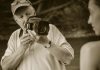
The German filmmaker (b. 1942) was the keynote speaker for “Night in the Library: The Philosophy of Mathematics,” and before taking the stage he acknowledged a slight worry that his remarks would exceed the allotted 20 minutes. He came prepared with little more than a wristwatch placed on the podium, a modest tool for a speaker known for turning the factual world into something stranger, more elastic, and more metaphysical.
The watch, by his own admission, did not fully succeed.
Herzog’s address was largely unscripted, and it moved quickly from the question of truth to the slipperiness of time itself. At one point he quoted Leonardo da Vinci: “Truth is the daughter of time.” But Herzog used the line less as a reassurance than as a provocation. Time, he suggested, is not a stable container for experience but “another framework for organizing our experiences” — a human-made structure that can be revised, resisted, or rewritten.
That impulse to push beyond plain documentary has long been central to Herzog’s work. His films often treat reality as a surface that can be punctured by awe, dread, or a sudden philosophical turn. He has previously offered a memorable example in 2010’s Cave of Forgotten Dreams, where he lingers on “mutant albino crocodiles” and asks, in one of his most surreal voiceovers, “Are we today the crocodiles who look back into the abyss of time when we see the paintings of Chauvet cave?”
At the library, the conversation about time took on a more personal register when Herzog spoke about his friendship with Hiroo Onoda, the Japanese soldier who continued fighting World War II for 30 years on a small island in the Philippines, long after the war had ended. Herzog later dramatized Onoda’s solitary campaign in his 2022 novel The Twilight World, but in Brooklyn he used the story to underline how time can fracture into competing realities.
“In concordance with Onoda,” Herzog said, “we are the ghost writers of our reality of time.”
The evening’s final moments landed, fittingly, on a passage about the divine. Near the end of his talk, Herzog began reading from Virgil’s Georgics, a section on bees that imagines their labor as something touched by heaven: “Some say the bees have drunk from the light of heaven,” the passage reads, “and have a share in the divine intelligence.”
Then Herzog stopped himself.
“I would like to read much more,” he said, “but I am over time.”
It was a tidy ending for a speaker who had spent the night questioning whether time can ever be tidy at all — and a reminder that even in a library, where centuries sit quietly on shelves, the most urgent ideas still arrive in the present tense.